Pediatric sepsis is a leading cause of death across the globe, particularly in low- and middle-income countries (LMICs).1 The Society of Critical Care Medicine (SCCM) Surviving Sepsis Campaign and other guidelines recommend early recognition and timely intervention to save children’s lives,2 but that can be challenging in LMICs.
Read the source article for this feature from
Pediatric Critical Care Medicine.
A new retrospective study shows that children with sepsis in a resource-limited setting in South America who received early administration of vasopressors and antibiotics were more likely to survive. The study findings from 14 hospitals across Bolivia were published in the February 2026 issue of
Pediatric Critical Care Medicine.
3
Just a few years ago, Bolivian physicians did not have concrete mortality rates for pediatric sepsis, although death rates were thought to be high. Thus, Raul Copana-Olmos, MD, and other physician researchers set out to quantify the risk. Dr. Copana-Olmos is a critical care assistant physician at Hospital del Niño Manuel Ascencio Villarroel and an assistant professor in the Faculty of Medicine at Universidad Mayor de San Simon, both located in Cochabamba, Bolivia.
In 2019, Dr. Copana-Olmos helped to develop the first epidemiological study of pediatric sepsis in Bolivia, discovering a 34% mortality rate among children with sepsis across four hospitals.
4 “We needed to look in the mirror at our own clinical reality,” he said. “That first approach let us know the high burden and high impact of mortality.”
With that knowledge, the researchers formed the Pediatric Research Sepsis Group, and in 2023, 14 hospital centers across Bolivia participated in the follow-up study.
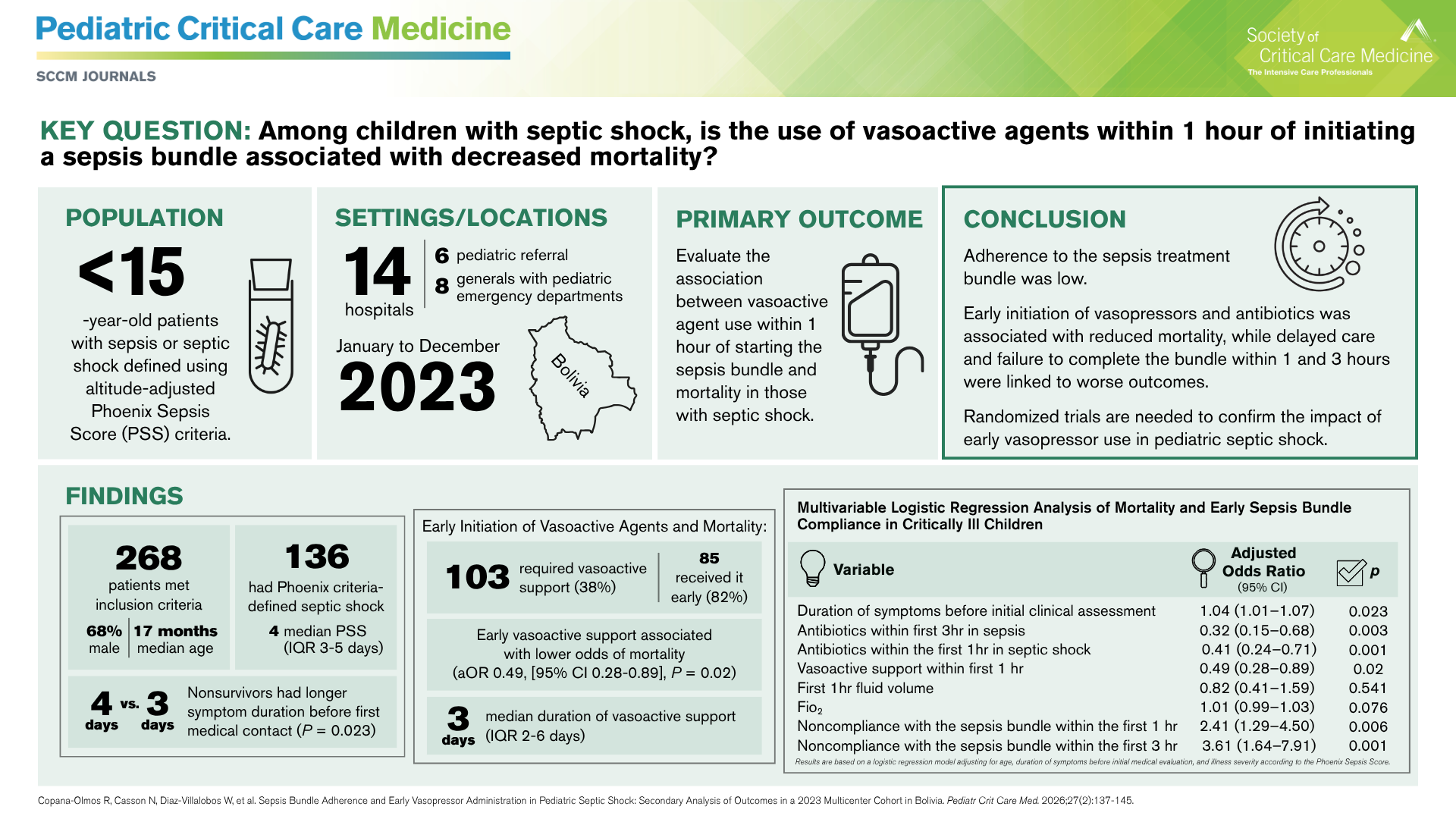
The new study included a cohort of 268 patients younger than 15 years. Researchers aimed to update Bolivia’s epidemiological data, evaluate the quick use of a vasopressor at the recognition of sepsis, and assess any associations between sepsis bundle adherence and mortality and other outcomes.
3
The Findings
The study showed low adherence to complete sepsis bundle care for children presenting to the emergency department or already hospitalized in the pediatric intensive care unit.
3 Sepsis bundle adherence was achieved in 42% of patients within the first hour and 49% of patients within the first three hours of care. Failure to adhere to the sepsis bundle was associated with greater odds for mortality.
While those findings among these low-resource settings did not surprise Dr. Copana-Olmos, other results were more surprising—and more promising.
The study showed that beginning vasopressor therapy within the first hour of care, via either peripheral or central venous access, was associated with lower odds of mortality.
3 Among 102 children who received vasopressors as part of the sepsis bundle, 83% received peripheral venous administration within the first hour of persistent hypotension without any record of adverse events. Norepinephrine alone was used in 49% of patients, epinephrine alone in 29%, and a combination of the two in 11% of patients. Dopamine or dobutamine was used in the remaining 11% of patients.
“That is a crucial point because historically, there has been a fear of using peripheral lines for vasopressors in children due to the traditional paradigm of aggressive fluid resuscitation. In Bolivia, the belief exists that fluids must flow endlessly before vasopressors are even considered,” Dr. Copana-Olmos explained. “Also, in Bolivia and other resource-limited settings, waiting for a central venous line can cause a delay and directly impact survival.”
These findings align with the updated 2026 Surviving Sepsis Campaign international guidelines, which support the early administration of vasopressors via peripheral intravenous lines.
2
“We demonstrated that this intervention is not only feasible, but also safe. The peripheral route is a safe bridge to stabilization.” This is important for resource-limited and rural settings and should empower physicians so that they can safely administer vasopressors through the peripheral intravenous route to try to halt the progression of septic shock, he said.
5
Furthermore, the study showed that early administration of antibiotics within the first hour for septic shock, and within the first three hours of sepsis, was associated with better clinical outcomes and higher odds of survival—even with lower adherence to the full sepsis bundle.
This is also encouraging for LMICs because antibiotics are often more readily available than vasopressors, he said. “In Bolivia and other resource-limited settings, where patients often present late to the emergency department, giving that first dose of antibiotics within the golden hour is perhaps the single most cost-effective and high-impact intervention we have available.”
Physicians in LMICs can face administrative delays in drug dispensing. However, when it comes to pediatric sepsis treatment, hospitals “must overcome that inertia and treat the first dose of antibiotics not as a pharmacy transaction, but as an emergency resuscitation maneuver—equivalent to defibrillation shock in a cardiac arrest,” Dr. Copana-Olmos noted. “Clinical suspicion must supersede bureaucratic hesitation.”
What’s Next
The Pediatric Research Sepsis Group is also interested in better understanding the physiology of children who live in high-altitude areas. About 500 million people across the world live at or above 1,500 meters above sea level, while about 82 million live at or above 2,500 meters. Bolivia has more people living above 2,500 meters than any other country on earth. How does living with thinner air affect children’s development and disease patterns?
6
In addition, now armed with evidence, the research group wants to move from observation to implementation. The next step is to build a standardized national quality improvement toolkit for treating children with sepsis, Dr. Copana-Olmos said.
He also encourages LMICs to stop waiting for an abundance of resources before acting. With the evidence that peripheral vasopressors are effective, “the barrier isn’t the cost of drug, but the delay in recognition and fear of the protocol. We must empower frontline clinicians to use standardized triage algorithms and treat the sepsis bundle not as a luxury but as an absolute emergency standard of care.”