Italian researchers have published the first known prospective study validating the Phoenix Sepsis Criteria (PSC) and Phoenix Sepsis Score (PSS) used to assess sepsis among children in Europe, further supporting the adoption of the criteria.
The Society of Critical Care Medicine (SCCM) Pediatric Sepsis Definition Task Force developed and published the Phoenix criteria in 2024 to replace the outdated 2005 International Pediatric Sepsis Consensus Conference (IPSCC) criteria, which had been written based on expert opinion but lacked data-driven evidence.
2
When first developed, the PSC were validated in a dataset of more than 3.6 million pediatric hospital encounters at 10 sites in five countries: the United States, Colombia, Bangladesh, China, and Kenya.
3 But only the U.S. data were obtained from a high-resource setting.
4
While the diverse, multicenter, retrospective cohort study
3 was valuable in the ongoing fight against sepsis, an Italian research group wanted to see how well the PSC could assess sepsis in Europe. The first author Luca Marchetto, MD, PhD, a pediatric intensivist in the Department of Women’s and Children’s Health at the University Hospital of Padua in Italy, and the research group published their findings in the June 2026 issue of
Critical Care Medicine.
4
The idea for the study began with Dr. Marchetto’s previous research on pediatric sepsis. As a PhD candidate in 2020, he conducted a small pediatric study at the University Hospital of Padua based on the IPSCC criteria. For his next study, he recruited eight pediatric intensive care units (PICUs) through the Italian Network of PICU Study Group (TIPNet).
4 Dr. Marchetto’s unit at the hospital served as the study’s coordinating center.
The group began collecting patient data during the first 48 hours after admission. “We decided to have a more ambitious plan and collect all the data beyond the initial 24 hours of admission,” Dr. Marchetto said. “We collected data on basically everything regarding organ support, organ dysfunction markers, laboratory analysis, ventilation, vasoactives, and extracorporeal support.”
As the data were being collected, the new PSC were published.
4 “We had been forward-thinking in designing such a comprehensive data collection, and we were fortunate that all the variables included in the PSS were already in our database,” he said. Thus, the team pivoted and worked to validate the PSC and the PSS in their population.
The Findings
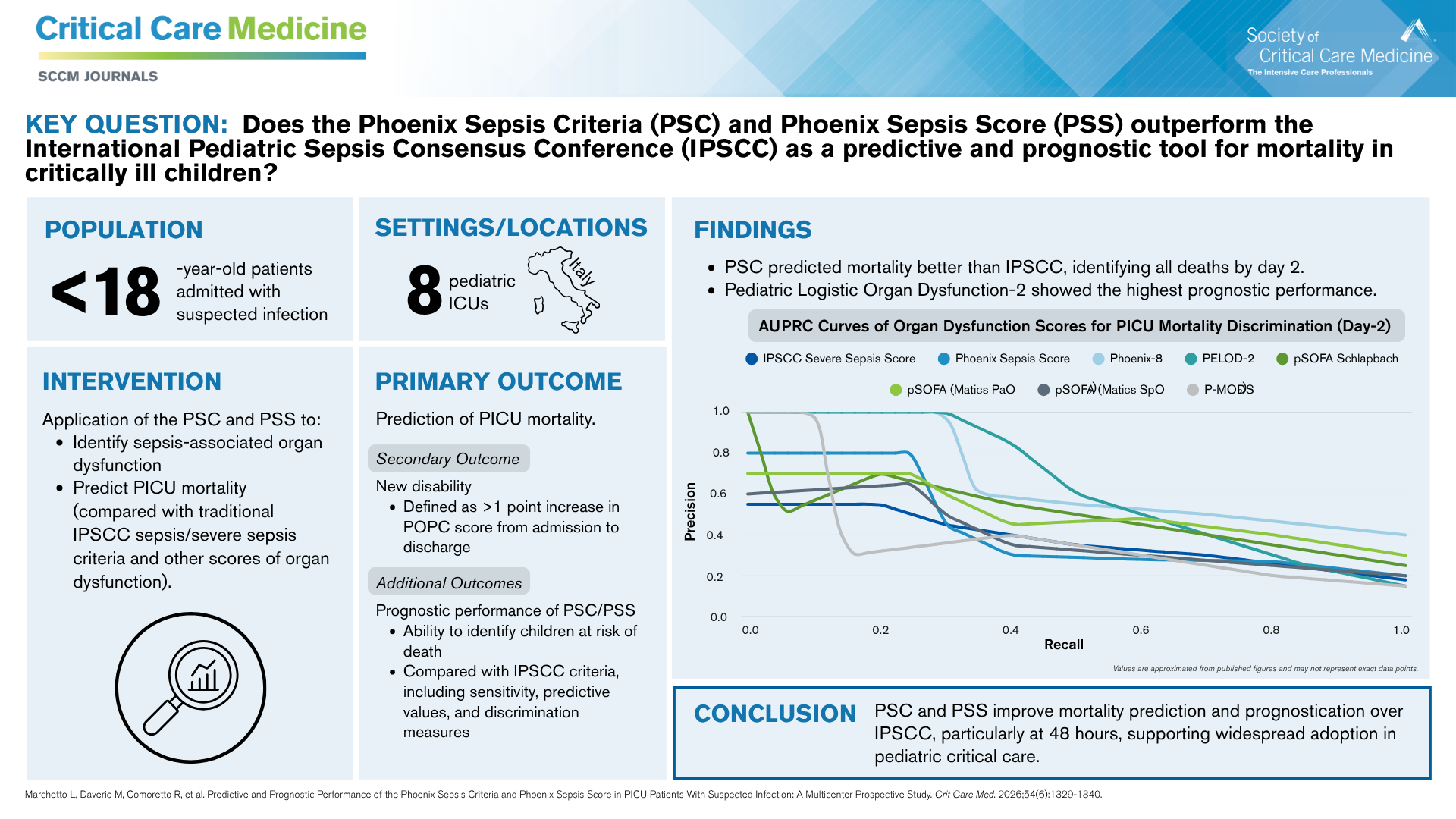
TIPNet’s cohort included patients younger than 18 years who were suspected to have infection and admitted to the eight participating TIPNet PICUs from February 2022 to April 2024. Vital signs, organ dysfunction markers, and organ support requirements were collected on days 1 and 2 of PICU admission.
4
Researchers assessed sepsis using both the IPSCC criteria and PSC. Among 687 patients, the PSC predicted mortality more accurately than the older IPSCC criteria.
4
“What was nice is that we were able to confirm the good performance of the PSC and the PSS in a European population, which wasn’t done in the original study,” Dr. Marchetto said. “Also, I think it is interesting that we were able to extend the window slightly beyond the first day. If you read the
JAMA Phoenix study, it’s the first 24 hours of admission,
3 but we had data from the first 48 hours. We were able to build a Phoenix sepsis score on the second day after admission, and we confirmed that it had an even higher prognostic performance.”
Of the 28 deaths in the study, the PSC predicted 27 deaths on day 1 and predicted all 28 by day 2. As sepsis evolves, assessment on day 1 may not always capture organ dysfunction, but by 48 hours, the nature of the disease is often more evident.
4
“I think the scientific community is trying to make study results more globally applicable, with more attention to resource-limited countries. At the same time, we thought it was important to include a country also from Europe,” Dr. Marchetto said. While the United States and European countries such as Italy are both considered high-resource settings, they have different healthcare systems, healthcare access, populations, and epidemiology, he explained.
What’s Next
The development and validation of the PSC have been groundbreaking, Dr. Marchetto said, and the Italian TIPNet community is proud to play a part in that research and in improving sepsis care.
“It’s very important to change the conventional understanding from five or six years ago. The PSC introduced the concept of organ dysfunction, while the previous sepsis criteria were broad and often presented even in patients who were not critically ill.”
Dr. Marchetto noted that the community still has a lot of work to do to better understand and treat sepsis. He outlined a few questions he hopes that research can help answer: Could the PSC also predict sepsis that develops during the hospital stay, rather than only at admission? Could the criteria predict long-term outcomes related to quality of life? Do any subcomponents of organ dysfunction predict sepsis mortality more than others? How does respiratory dysfunction compare with liver dysfunction or coagulation abnormalities?
“Our database is very large, and we have all these subcomponents of organ dysfunction, but we clustered all of them together,” he said. “Examining the subcomponents is definitely part of our future effort. Within our database, we could examine a single organ dysfunction and try to understand how it affects mortality.”