







Guidelines on Caring for Older Adults in the ICU
Citation: Ferrante LE, Chaudhuri D, Laiya Carayannopoulos K, et al. Society of Critical Care Medicine guidelines on caring for older adults in the ICU. Crit Care Med. 2026 Mar. Forthcoming.
Rationale: Older adults (those 65 years old or greater) compose a substantial proportion of the ICU population. As older adults with critical illness possess unique factors and considerations relevant to their care and outcomes, there is a need for evidence-based recommendations to guide critical care clinicians in the care of older ICU patients.
Objective: The objective of this guideline is to develop evidence-based recommendations addressing the care of older adults during and after critical illness.
Design: The American College of Critical Care Medicine Board convened a 22-member interprofessional panel, comprising physicians, advanced practice providers, nurses, a pharmacist, physical therapist, occupational therapist, and a patient representative. The panel included two expert methodologists specialized in developing evidence-based recommendations in alignment with the Grading of Recommendations, Assessment, Development, and Evaluation (GRADE) methodology. Conflict-of-interest policies were strictly followed during all phases of guideline development including task force selection and voting.
Methods: The panel members prioritized five Population, Intervention, Comparator, and Outcomes (PICO) questions. A systematic review was conducted for each question to identify the best available evidence, synthesize the evidence and assess the certainty of evidence using GRADE. The evidence-to-decision framework was used to formulate recommendations.
Results: The panel generated two conditional recommendations and three “no recommendation” statements. The conditional recommendations are: 1) We suggest a geriatric model of care for all older adults admitted to the ICU and 2) We suggest not using antipsychotic medications for the prevention of delirium in older adults with critical illness. The three “no recommendation” statements are: 1) We make no recommendation regarding specialized post-ICU follow up for older survivors of critical illness, 2) For older adults (age 65 and over) admitted to the ICU with vasodilatory shock, we make no recommendation with regard to targeting a mean arterial pressure (MAP) of 60-65 mm Hg as compared with usual care (MAP target > 65 mm Hg), and 3) We make no recommendation regarding the use of antipsychotic medication in the treatment of delirium in older adults with critical illness.
Conclusions: The guideline panel developed recommendations on caring for older adults during and after critical illness. Areas for future research were also identified during the guideline process.
Guideline Type: Clinical
Related Resources:
 |
Implementation Toolkit: Guidelines for Caring for Older Adults in the ICU |
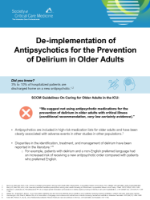 |
Infographic: De-implementation of Antipsychotics for the Prevention of Delirium in Older Adults |
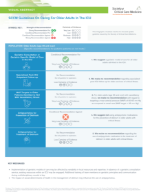 |
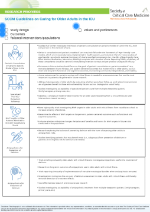
Visual Abstract: SCCM Guidelines On Caring For Older Adults In The ICU |
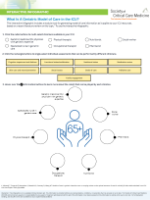 |
Interactive Infographic: What Is A Geriatric Model of Care in the ICU? |
 |
Interactive Infographic: Research Priorities: SCCM Guidelines on Caring for Older Adults in the ICU |
 |
Podcast: SCCMPod-567 CCM: Caring for Older Adults in the ICU |
Identifier:
Strength:
We suggest a geriatric model of care for all older adults admitted to the ICU.
Certainty of evidence: Very low
We make no recommendation regarding specialized post-ICU follow-up for older survivors of critical illness.
Certainty of evidence: Low
For older adults (age 65 and over) with vasodilatory shock, we make no recommendation with regard to targeting a MAP of 60-65 mm Hg as compared with usual care (MAP target > 65 mm Hg).
Certainty of evidence: Very low
We suggest not using antipsychotic medications for the prevention of delirium in older adults with critical illness.
Certainty of evidence: Very low
We make no recommendation regarding the use of antipsychotic medication in the treatment of delirium in older adults with critical illness.
Certainty of evidence: Low
MAP = mean arterial pressure.