





Citation: Derrington S, Broden Arciprete E, Lin MC, et al. Society of Critical Care Medicine 2026 guidelines on the care and management of pediatric and neonatal intensive care patients at the end of life. Ped Crit Care Med. 2026 Mar. Forthcoming.
RATIONALE: Ensuring high-quality end-of-life (EOL) care for neonatal and pediatric patients and their families in the ICU requires a comprehensive, evidence-based, multidisciplinary approach.
OBJECTIVES: To develop and provide evidence-based recommendations for EOL care and management of critically ill neonatal and pediatric patients and their families.
DESIGN: The American College of Critical Care Medicine Board convened a 21-member multidisciplinary panel of experts in pediatric critical care medicine, nursing, neonatology, psychology, spiritual care, social work, child life, respiratory care, bioethics, cardiology/cardiac intensive care, palliative care, and bereaved parents. The panel included two expert methodologists specialized in developing evidence-based recommendations in alignment with the Grading of Recommendations, Assessment, Development, and Evaluation (GRADE) methodology. Conflict-of-interest policies were followed during all phases of guideline development including task force selection and voting.
METHODS: The panel members identified and formulated five Population, Intervention, Comparator, and Outcome (PICO) questions. We conducted a systematic review of literature (2000-2025) for each question to identify best available evidence, then statistically analyzed and assessed the certainty of evidence using the GRADE methodology. We used the GRADE evidence-to-decision framework to formulate the recommendations.
RESULTS: The panel generated five conditional recommendations and one good practice statement, focused on advance care planning, pediatric palliative care consultation and education, systematic symptom management, bereavement support, and health equity in EOL care.
CONCLUSION: The recommendations were derived from the best available evidence at time of publication and provide valuable guidance to support EOL care for PICU and neonatal ICU patients and their families.
Guideline Type: Clinical
Related Resources:
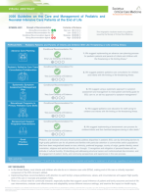 |
Visual Abstract: 2026 Guideline on the Care and Management of Pediatric and Neonatal Intensive Care Patients at the End of Life |
 |
Implementation Toolkit: 2026 Guideline on the Care and Management of Pediatric and Neonatal Intensive Care Patients at the End of Life |
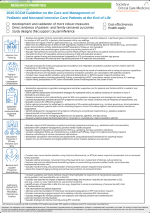 |
Interactive Infographic: Research Priorities |
Identifier:
Strength:
We suggest implementing an advance care planning process for pediatric patients and parents of infants and children with life-threatening or life-limiting illness.
Certainty of evidence: Very low
We suggest pediatric palliative care consultation for children and infants with life-limiting or life-threatening illness.
Certainty of evidence: Very low
We suggest using a systematic approach to symptom assessment and management to meet patient and family goals for EOL care vs. an ad hoc approach to symptom management.
Certainty of evidence: Very low
We suggest palliative care education for staff caring for children and infants with life-limiting or life-threatening illness.
Certainty of evidence: Very low
We suggest implementing a bereavement care process for children/infants and their families/caregivers during or after death.
Certainty of evidence: Very low
Pediatric and neonatal clinicians should actively address disparities in pediatric EOL care by eliminating barriers to high-quality palliative care for all patients and families with particular attention to communities and/or populations that have been marginalized based on race, ethnicity, preferred language, country of origin, gender identity, sexual orientation, religious and spiritual identity, etc. through: 1) recognition and mitigation of personal biases with an attitude of cultural humility, 2) identifying and addressing structural racism and institutionalized discrimination, and 3) engagement of patient, family, and community perspectives and experiences in the care process.
EOL = end-of-life.