

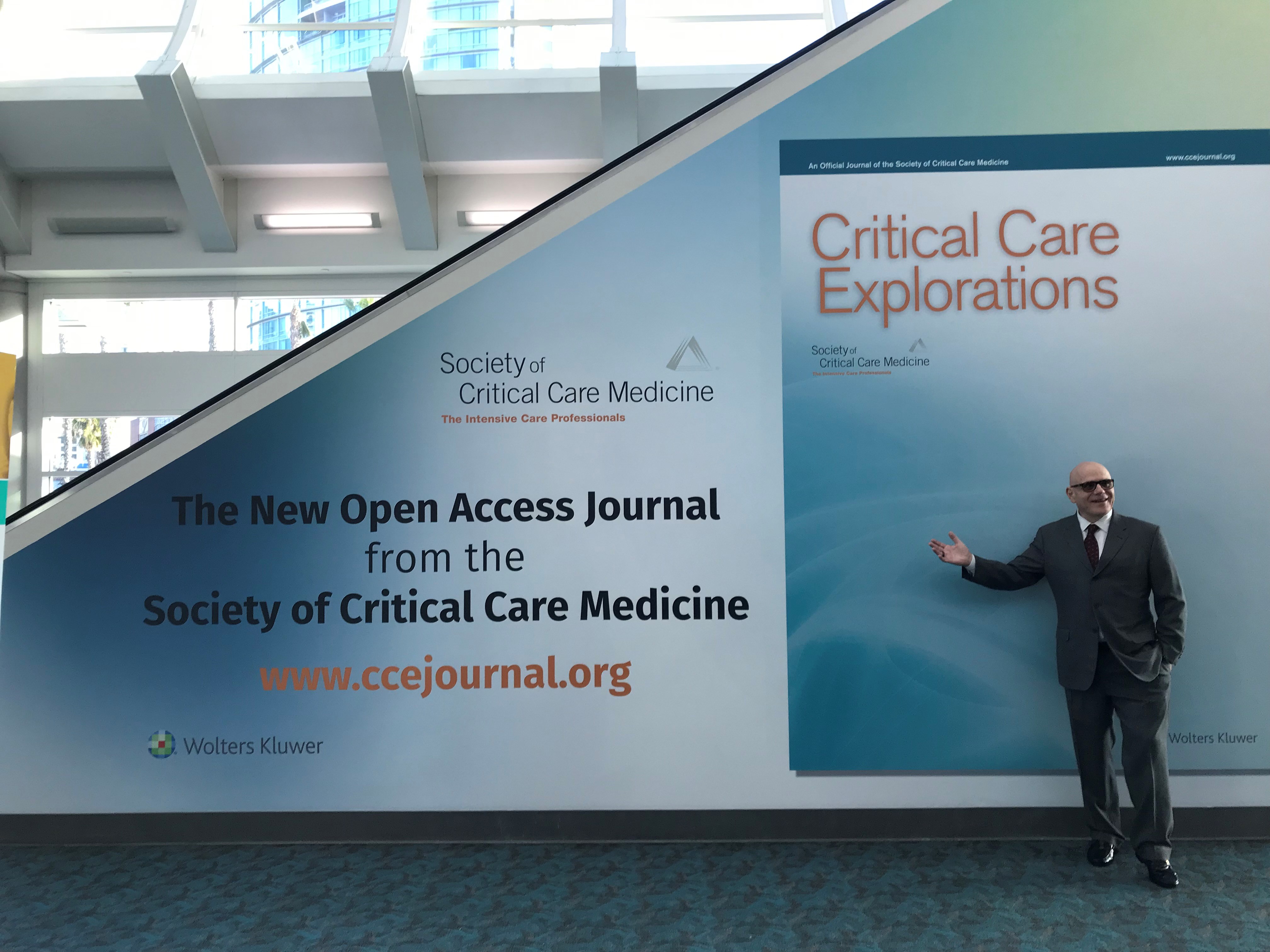
SCCM’s 2019 Critical Care Congress in San Diego held a couple of personal highlights. The Society launched the open-access journal Critical Care Explorations, an undertaking that has since grown into an enormous success, now helmed by my friend and colleague, Dr. Tamás Szakmány.
But you didn’t come here to read about a journal launch. You came for a sepsis survival story. That brings me to my second highlight. Or, more honestly, my lowlight.
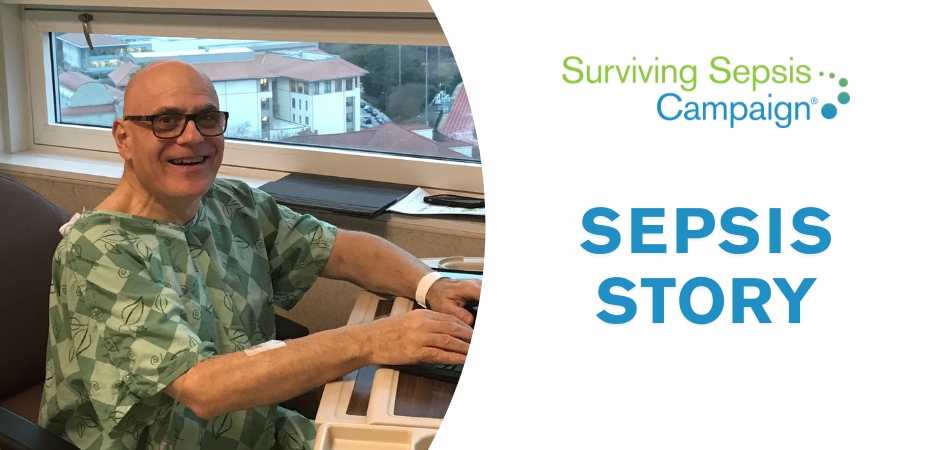
Let me take you back to Tuesday, February 19, 2019. I woke up in my hotel room feeling a bit off. You know the feeling—too many early mornings, too many late nights, and sleep that doesn’t quite do what it’s supposed to. No matter, I told myself. It was my last day: a couple more talks, then the red-eye home. (I hate red-eyes, but there was a delegation of visitors from China at the meeting who would follow me to Atlanta. I had arranged a tour and an official dinner, and I wanted to get home in time to make sure everything was ready.)
Fast forward: I’m in room 33 with close friends and critical care colleagues—Donna Armaignac, Craig Lilly, Jeremy Kahn, and Michael Ries. The topic was telemedicine; the session title was “Telemedicine Is Medicine, Tele-ICU Is ICU, Tele-Healthcare Is Healthcare.” I’m feeling achy, and—entirely out of character for me—I bum a couple of ibuprofen from Donna.
I give my talk. Later, I watched the recording just to reassure myself I didn’t look sick. (It’s still out there on YouTube if you want to decide for yourself.) I make it through the rest of the session.
I feel worse, nap briefly, then head downstairs for the ride to the airport. One of my eICU nurses, Patti Berdini, rides with me and tells me I don’t seem like my usual self. She recommends I sleep on the flight home.
Yes, ma’am.
I vaguely remember settling into the seat. The next thing I know there’s a ding and everyone is standing up, grabbing their rollerboards. I make it to baggage claim, into a rideshare, and somehow home.
My wife, Barb, takes one look at me and says I look “lousy,” then ushers me straight to my own bed in my own house—surely the most restorative place on earth.
Hours later, she has trouble waking me. She looks at my left leg—or more precisely, the progressive streaky erythema that has crawled from foot to mid-calf to knee. (I know what you’re thinking. No, it was not a DVT. No, I’m not diabetic.)
As it happened, my personal physician was also a neighbor two blocks away. Barb called him. He trotted over, took one look, noted I was tachypneic and a bit confused, and within minutes told her to take me straight to the hospital admitting office. He was calling ahead—antibiotics, labs, the whole cascade.
I don’t remember much about the admitting office except that the light hurt my eyes. Apparently, I would rouse briefly, mumble something incoherent, and fall back to sleep.
Note to self: One can be blissfully unaware of one’s own delirium.
If you’re a critical care professional reading this, you can probably write the next three lines yourself:
Erysipelas.
Streptococcus.
Vancomycin and piperacillin/tazobactam—quickly narrowed to cefazolin.
What, you want my SOFA details so you can decide whether I met Sepsis-3 criteria? Fair enough. Bilirubin 2.2 mg/dL. Creatinine 2.2 mg/dL—both normal on routine labs two months earlier. So . . . yes. But you could have made the call on qSOFA with tachypnea and confusion alone, right?
I didn’t make the dinner. Craig Coopersmith and Greg Martin dropped what they were doing to host it, and Barb went in my place. They told me it was a lovely meal. It had to have been nicer than the turkey sandwich and Diet Coke that appeared on my hospital tray.
By the next day, I felt better. The journal submissions kept coming. There were editors to assign, decisions to make, emails to answer. (Of course there were.)
There were also well-wishers. One of them—a senior colleague, someone I know to have the most gracious and compassionate of bedside manners—walked in, looked me over, and said I was “a [expletive] idiot” for imagining I was exempt from sepsis, an illness that I study and treat.
Umm.
I recovered. My lower-extremity lymphatics, not so much. I’ve resigned myself to a life of compression hosiery—a small price to pay and a gentle, constant reminder that none of us are invulnerable to sepsis.
I no longer imagine myself to be invulnerable. That big red “S” on my chest? I learned it stands for “sepsis.”